Sand Tray Therapy for Adults: Why a Wordless Approach Helps When Talk Therapy Feels Stuck
There is a particular kind of therapy client who is very good at therapy. They arrive on time, they have read about attachment theory, and they can describe their childhood with real accuracy and even some humor. They can tell you exactly why they react the way they do, name the pattern, trace it back to its origin. And after a year of this, the pattern is still running.
Insight and change are not the same thing, which is one of the more frustrating truths in mental health treatment. Understanding why you flinch does not automatically stop the flinch. There is also a second group of adults who arrive at the opposite problem, sitting in the room genuinely unable to find words for what happened or what they feel, and leaving each session with the sense that they talked around the thing for fifty minutes without ever touching it. Sand tray therapy is often useful for both, and it is far less commonly offered to adults than it should be.
Why Talk Therapy Sometimes Stalls for Adults Who Can Already Explain Their Problems
Conventional talk therapy works from the top down, meaning it engages the parts of the brain that handle language, reasoning, and narrative, then works toward changing what happens lower down in the emotional and physical systems. That direction of travel is effective for a great deal of what brings people to counseling. It has a known limitation, though, which is that a person who is highly verbal can use language itself as a way of keeping distance from an experience. Explaining a painful event in fluent, organized sentences can feel like processing it while actually functioning as a way to stay safely above it.
Clinicians sometimes call this intellectualizing, though the term can sound like an accusation and is not meant as one. It is usually a skill someone developed for good reason, often in a household where being articulate and self-aware was the safest way to be. The difficulty is that a strategy built to manage overwhelm can later prevent the very processing a person is now paying to do. When someone tells us they have been in therapy for years and understand themselves completely but nothing has shifted, the approach itself is often worth reconsidering rather than the person's effort or commitment.
What Sand Tray Therapy Is and How an Adult Session Works
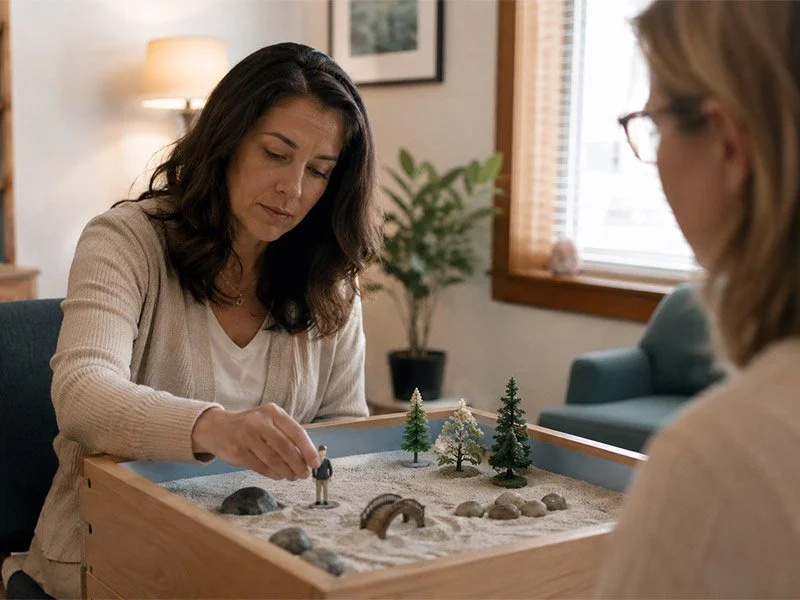
The physical setup is straightforward. There is a shallow rectangular tray, traditionally around 28 by 19 inches and painted blue on the interior so the bottom can suggest water and the sides sky, filled partway with sand that may be dry or dampened. Nearby sits a collection of small figures, usually organized on shelves by category: people of different ages and roles, domestic and wild animals, houses and bridges and fences, vehicles, trees and stones and shells, and symbolic or mythical objects. The tray size is not arbitrary, since it is meant to sit entirely within your field of vision without requiring you to turn your head, which keeps the whole scene containable.
The process asks very little in the way of instruction. Your therapist invites you to choose figures that draw your attention and place them in the sand however you like, with no requirement to plan, explain, or make anything that looks like something. Some people work quickly and some take most of the session, and either is fine. What tends to surprise adults is how quickly the choosing stops feeling deliberate, since people frequently report reaching for objects without knowing why and only recognizing the significance afterward, sometimes days later.
What the therapist does during this is less obvious but matters enormously. They stay present and quiet, tracking where you hesitate, what you pick up and put back, which corner of the tray you avoid, and how your body changes as the scene develops. Afterward, depending on the approach, they may invite you to say something about the world you made, ask what a particular figure is doing there, or simply sit with it alongside you. Interpretation is not imposed on you, and a well-trained clinician will not tell you what your tray means.
The Difference Between Sandplay Therapy and Sand Tray Therapy
These two terms get used interchangeably in casual conversation, but they refer to meaningfully different traditions, and knowing which one a practice offers is genuinely useful information. The technique originated with Margaret Lowenfeld, a British pediatrician who developed what she called the World Technique with children in London in the late 1920s. Dora Kalff, a Swiss analyst who studied with Lowenfeld and trained in Jungian psychology, later developed Sandplay in the middle of the twentieth century, integrating Jungian concepts of the unconscious and archetypal symbolism. Sandplay in the Kalffian tradition is highly non-directive, with the therapist maintaining what Kalff described as a free and protected space and generally withholding interpretation during the process entirely.
Sand tray therapy, spelled as two words and sometimes as sandtray, is the broader and more flexible term. It describes the use of the tray and miniatures within whatever theoretical orientation the clinician already practices, which might be person-centered, Gestalt, cognitive behavioral, or attachment-based. A sand tray therapist may be considerably more directive, offering a prompt, asking questions during the build, or inviting you to rearrange the scene to explore what a change would feel like. Structured models exist for this, including the widely taught six-step approach developed by Homeyer and Sweeney. Neither tradition is superior, and the practical implication is simply that the experience will feel different depending on which one your clinician was trained in, so it is a reasonable thing to ask about.
Why Sand Tray Therapy Is Not Only for Children
The assumption that this is a children's intervention has a real historical basis, since Lowenfeld developed it for children and much of the professional training in the United States still lives within the play therapy world. That history has produced a lasting and mistaken impression. The underlying rationale for using it with children applies almost identically to adults: children benefit because their capacity for verbal expression has not caught up with their experience, and adults carrying trauma, grief, or preverbal material are in a structurally similar position. Language is not the only route to processing, and it is not always the best one.
The embarrassment adults feel about this deserves direct acknowledgment rather than reassurance that skips past it. Most people's first reaction involves some version of feeling too old for a sandbox, or worrying they are not creative enough to do it correctly. Both concerns are extremely common and neither holds up in practice, partly because there is no artistic skill involved in placing objects in sand and no aesthetic standard being applied. The self-consciousness usually fades within the first several minutes, and many adults describe the experience afterward as absorbing rather than silly, which is not something people generally anticipate walking in.
What Sand Tray Therapy Helps Adults Work Through
The approach is used across a wide range of concerns, and it tends to be selected less because of a specific diagnosis than because of how a person processes. That said, some situations come up repeatedly in adult work:
Trauma that resists narration. Experiences that happened before language developed, or that involved the kind of overwhelm where memory encodes as sensation and image rather than story, often have no coherent account attached. Being asked to describe them in sequence can be an impossible task rather than a therapeutic one. Building a scene bypasses that requirement completely. For readers wanting general background on how trauma affects functioning, the National Institute of Mental Health maintains an accessible overview.
Grief and loss. Bereaved adults frequently report that talking about a death produces the same few sentences over and over, worn smooth from repetition and no longer connected to feeling. Working in the tray tends to interrupt that loop. It also gives people a way to represent relationships and absences spatially, which can surface things that direct conversation about the loss does not reach.
Decisions and life transitions that feel impossible to think through. Divorce, career change, relocation, caregiving, and similar crossroads often produce a mental circling that more analysis does not resolve. Externalizing the situation into a physical scene puts the competing pressures where you can see them at once. Some people find this clarifying in a way that another round of pro and con lists is not.
Emotions that are difficult to name or express. Adults who grew up where feelings were not discussed sometimes genuinely lack the vocabulary rather than the willingness. The tray removes the need for that vocabulary as a prerequisite to doing the work.
Feeling stuck after substantial talk therapy. When someone has done significant work and reached a plateau, changing the mode of engagement is sometimes more useful than continuing the same mode with greater intensity.
Why a Nonverbal Approach Can Reach What Talking Cannot
The clinical reasoning here rests on a distinction between two kinds of memory, and it is worth explaining in plain terms because it clarifies a great deal. Explicit memory is what most people mean by memory: facts and events you can consciously recall and describe, handled largely by structures that developed alongside language. Implicit memory covers learned patterns that operate without conscious recall, including the way your body braces before you have registered why, or how you respond to a raised voice before any thought has formed. Overwhelming experiences tend to lay down strong implicit traces, which is a reasonable explanation for why a person can know intellectually that they are safe now while their body continues to behave otherwise.
Working with images and objects engages perceptual and spatial processing rather than running everything through verbal narration first. That shift is the entire point of the exercise. It is also worth being clear that the neuroscience here is a reasonable working model rather than a settled mechanism, and any practice claiming to have proven exactly what happens in the brain during a sand tray session is going beyond the evidence. What can be said with more confidence is the clinical observation that material reliably surfaces in the tray that had not surfaced across many sessions of conversation, and that this is the practical reason clinicians keep the approach available. You can read about the other treatment methods our clinicians use, several of which work through similar bottom-up principles.
What the Research Says About Sand Tray Therapy for Adults
Honesty about the evidence matters more than enthusiasm. The research base for sand-based therapy is real but modest, and it is considerably thinner for adults than for children, which the researchers themselves say plainly. A 2019 review by Roesler published in The Arts in Psychotherapy identified 16 randomized controlled trials and 17 effectiveness studies, finding significant improvements with moderate effect sizes across a range of child and adult mental health concerns. That same review notes an interesting wrinkle: relatively few empirical studies appear in English-language journals, while a substantially larger body of work exists in Chinese and Korean publications, which means English-speaking clinicians have historically seen an incomplete picture of the literature.
More recently, Schoonover and colleagues published a study in the Journal of Creativity in Mental Health examining sand tray therapy specifically with adults who had experienced trauma. Five participants completed seven to nine 50-minute sessions using a structured single-case research design, and four of the five showed decreases in trauma symptoms. A meta-analysis by Holliman and Foster in 2023, covering thirty-six studies of sand-based approaches, reported a large overall effect size. These findings are encouraging rather than conclusive, since small samples, single-case designs, and variation in how the approach is delivered all limit how far the results generalize. Sand tray therapy can help, and the honest framing is that it is a promising approach with a growing evidence base rather than a proven front-line treatment.
What to Expect in a First Sand Tray Therapy Session
Nothing about a first session requires preparation, and there is no way to do it wrong, which is worth stating plainly because most adults arrive worried about exactly that. Your therapist will typically spend part of the initial appointment on ordinary intake conversation, understanding what brought you in and what you have already tried, before introducing the tray at all. Some clinicians will suggest it in the first meeting and others will wait until a working relationship is established. You are never obligated to use it, and declining is a legitimate answer that will not be treated as resistance.
When you do work in the tray, the invitation is usually as simple as being asked to build a world, or to place whatever draws you. There is no expectation of explaining as you go, and silence during the process is normal and often productive. Sessions typically run the standard 50 minutes, with the building itself often taking twenty to thirty of those and the remainder spent looking at what emerged together. Many people find they are more affected by it than they expected, and it is entirely reasonable to tell your therapist that you want to slow down or stop at any point.
Sand Tray Therapy for Adults at Our Redding Counseling Center
Discover Hope Therapy is a group practice in Redding with nine clinicians, a mix of licensed therapists and registered associate clinicians working under licensed supervision. We offer sand tray therapy for adults as well as for children and teens, alongside EMDR, Brainspotting, Emotionally Focused Therapy, Acceptance and Commitment Therapy, and cognitive behavioral approaches. Having a range of clinicians with different training is what makes it realistic to match a person to an approach rather than fitting everyone into whatever the practice happens to do. You can read about each clinician's background and specialties on our therapist pages and see the full range of counseling services we provide.
One practical point matters for planning. Sand tray work requires being in the room with the tray, so it is an in-person service at our Redding office rather than something we can offer over video. If you are in Redding, Anderson, Shasta Lake, Palo Cedro, Cottonwood, or Red Bluff, that is generally a manageable drive for individual in-person therapy. If you are farther out in Northern California and traveling is not realistic, our telehealth services are available anywhere in California at the same rates as in-office sessions using other approaches, and a consultation can help you figure out whether making the trip for sand tray work makes sense for your situation. Questions about fees and insurance are answered on our therapy resources page.
Frequently Asked Questions About Sand Tray Therapy for Adults
Do I need to be creative or artistic to do sand tray therapy?
No, and this is probably the most common hesitation adults raise before trying it. There is no artistic technique involved, nothing is being evaluated aesthetically, and people who describe themselves as having no imagination at all do this work effectively. The process asks you to notice what draws your attention and place it, which is a matter of attention rather than talent. If anything, adults who are less invested in making something look good sometimes settle into it faster.
Will my therapist analyze what I build and tell me what it means?
A well-trained clinician will not hand you an interpretation, and any therapist who confidently decodes your tray for you is practicing outside the spirit of the approach. Symbol dictionaries exist in the literature, but the meaning of a figure depends entirely on your history and associations rather than on a universal key. Your therapist is more likely to ask open questions about what you notice, or to sit with the scene alongside you without pushing toward conclusions. What a tray means is something you arrive at, sometimes not until well afterward.
Is sand tray therapy the same thing as play therapy?
They overlap but are not identical. Play therapy is a broad framework for working with children through their natural medium of play, and sand tray is one of many tools used within it. Sand tray therapy is also practiced with adolescents and adults outside of any play therapy framework, within whatever theoretical orientation the clinician uses. The confusion is understandable given that much of the training in the United States is housed in play therapy programs.
Can sand tray therapy be done online?
Not in its traditional form, since the physical tray, the sand, and the tactile experience of handling objects are central to how it works. Some digital sandtray platforms exist, but their clinical effectiveness has not been meaningfully established in research, and we would not present them as equivalent. For clients who cannot travel to our Redding office, there are other approaches that work well over secure video and address similar material through different routes. A consultation is the easiest way to sort out which option fits.
How many sand tray sessions will I need?
There is no standard number and anyone offering a specific figure is guessing. Some people use the tray occasionally within an otherwise conversational course of therapy, while others work in it regularly for months. Research studies have used ranges like seven to nine sessions, though a study protocol and an individual treatment plan are different things. Your therapist should be discussing progress with you openly and adjusting as you go.
Is sand tray therapy appropriate for trauma?
It is used with trauma frequently, and the ability to work with material that resists narration is one of the main reasons clinicians reach for it. Pacing matters a great deal here, as it does with any trauma work, and a responsible therapist will attend to stabilization before opening difficult material. If you have a trauma history, mention it early so it can shape the treatment plan from the beginning. It is also worth noting that our practice does not prescribe medication or provide psychiatric evaluation, and we will help coordinate with a medical provider when that is part of the picture.
If You Want to Talk It Over First
If talk therapy has stopped moving for you, or if you have been sitting in sessions unable to find the words for what you actually need to say, sand tray therapy may be worth exploring. We offer a free 15-minute consultation where you can describe what you are dealing with and ask whatever questions you have, including practical ones about how it works and whether it would suit you. If we think a different approach or a different practice would serve you better, we will tell you that honestly. Nothing about the consultation obligates you to schedule an appointment.
You are welcome to get in touch when you are ready, or call our Redding office at (530) 206-5560. We are open Monday through Thursday, 9am to 7pm, and we work with clients throughout Redding, Shasta County, Tehama County, and the surrounding Northern California communities. Not being able to explain something yet does not mean you are not ready for therapy, and it is often precisely the reason to start.